

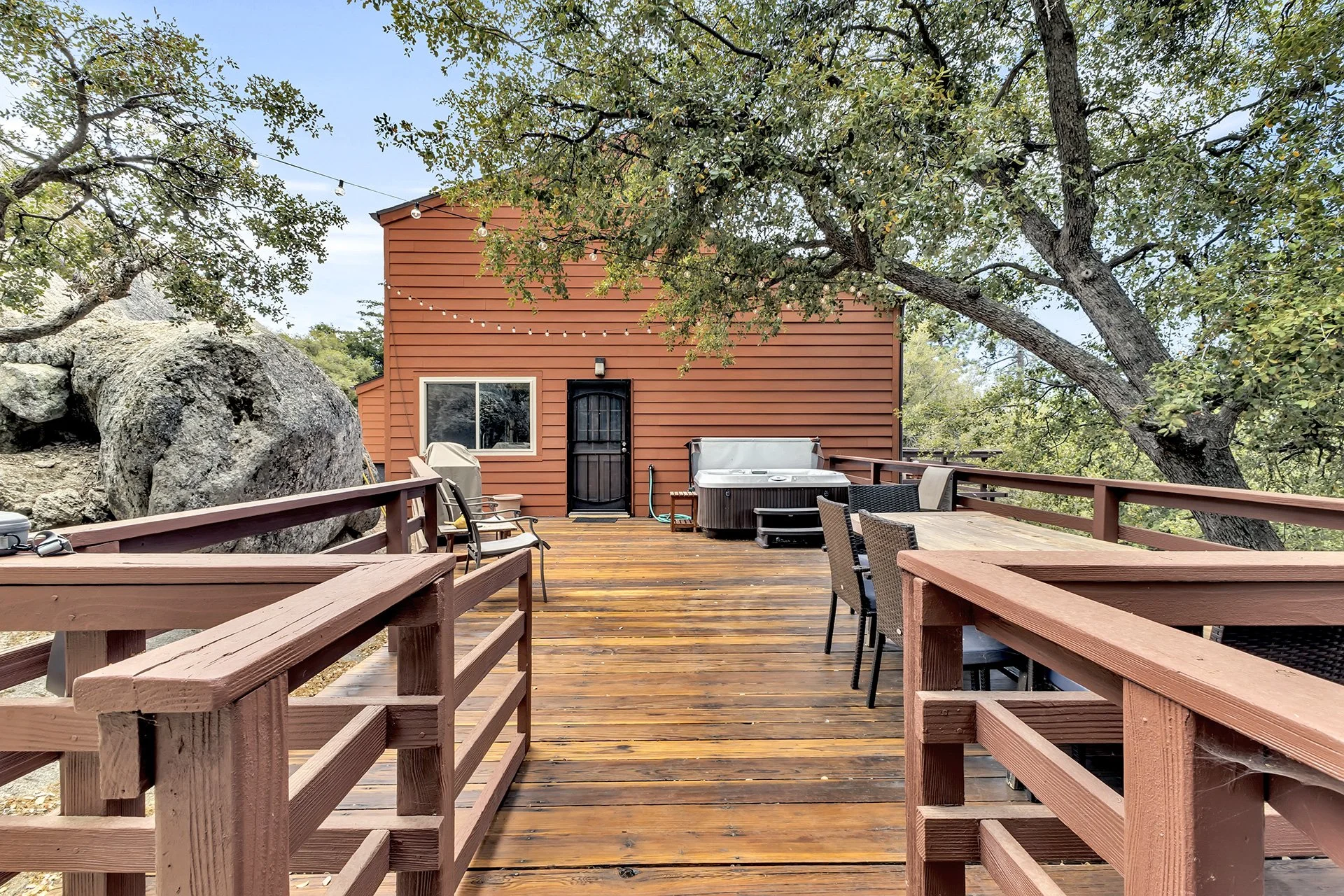
Home I listed and sold in 2025
Amazing location with the most massive boulder I’ve ever seen.
Why determining a home's market value requires more than comparable sales and an online estimate.
If you've ever looked up your home's value online, you've probably noticed that different websites can give you very different numbers. Sometimes the differences are substantial.
There's a reason for that, especially in a market like Idyllwild.
Our homes aren't particularly easy to categorize. We have historic cabins, contemporary mountain homes, rustic retreats, custom-built properties, and everything in between. Two homes on the same street can have entirely different characteristics, and those differences can have a significant impact on value.
Determining what a property is worth requires more than entering an address into a computer.
Not All Comparable Sales Are Created Equal
When I'm researching a property's value, I start with recent sales. But finding properties that have sold is only the beginning.
In a typical suburban neighborhood, you might find several homes with similar floor plans, square footage, construction dates, and lot sizes. That makes comparisons relatively straightforward.
Idyllwild is a different story.
A 1,200-square-foot cabin built in the 1940s might have little in common with another 1,200-square-foot home built in the same decade.
One may have been extensively remodeled, while the other retains much of its original construction. One might sit on a level, usable lot with easy year-round access. The other could be perched on a steep hillside with limited parking.
Even the setting matters. Privacy, sunlight, views, road noise, and proximity to town can all influence how buyers perceive a property.
These differences aren't always reflected in public records or automated valuation systems.
And they certainly aren't captured by square footage alone.
What Buyers See Matters
Property condition is another important consideration, and I'm looking beyond whether a home is attractive.
I'm considering the roof, foundation, heating system, windows, drainage, and the general quality of improvements. I'm also looking at issues that can be particularly relevant to mountain properties, including access, defensible space, and the condition of decks and exterior woodwork.
Some improvements add measurable value. Others make a home more appealing or easier to sell without necessarily returning every dollar spent.
I've seen beautifully maintained older cabins that buyers respond to immediately. I've also seen recently remodeled properties where the improvements weren't particularly well suited to the home or the market.
A seller may have invested a considerable amount of money in renovations, but the market doesn't automatically reimburse renovation costs.
The question is how those improvements affect the property's appeal and value compared with competing homes.
The Asking Prices of Other Homes Don't Tell the Whole Story
One of the most common mistakes sellers make is looking at what neighboring properties are listed for and assuming their own home should be priced similarly.
But an asking price is just that. It's what a seller hopes to receive.
A home can be listed for $600,000 without being worth $600,000.
I study active listings because they tell me what buyers have available to choose from. But I also look closely at closed sales, pending transactions when reliable information is available, price reductions, and how long properties have been on the market.
I'm particularly interested in what buyers are actually responding to.
A property that has been sitting on the market for months can tell us something useful, especially when comparable homes have sold during that same period.
The market provides feedback. Sometimes that feedback isn't what a seller wants to hear, but ignoring it doesn't change the reality.
Pricing Is Also About Timing and Competition
Market value isn't a fixed number that remains unchanged throughout the year.
Inventory, interest rates, buyer demand, insurance availability, and competing listings can all affect a property's marketability.
A price that might have been reasonable in a particularly active market may not be supported under different conditions.
This is why I don't rely exclusively on historical sales. I also consider what's happening in the market right now.
And while I understand why sellers want to leave room for negotiation, pricing a property too high can work against them.
Today's buyers have access to an enormous amount of information. They can compare homes, review pricing histories, and recognize when a property doesn't appear competitive.
A home that enters the market at an unrealistic price may miss the attention of buyers who would otherwise have considered it.
Reducing the price later can help, but it doesn't always recreate the interest that a well-priced new listing might have received.
An Algorithm Has Never Stepped Foot Inside Your Home
You won't find an instant home valuation tool on my website, and that's intentional.
Automated estimates can be useful as a general reference, but they have limitations, particularly in a market with such a wide variety of properties.
An algorithm hasn't walked through your home. It hasn't evaluated the quality of your improvements, noticed the afternoon sunlight streaming through your windows, or considered the challenges of your driveway after a winter storm.
It may not recognize that the home down the road has an unpermitted addition, or that a seemingly similar property has a very different setting.
Those details matter.
And while technology is a valuable part of researching real estate, I don't believe it replaces the judgment and experience required to interpret the information.
My Approach to Pricing Your Home
I've been working in the Idyllwild real estate market for decades, and one thing I've learned is that every property deserves an individual assessment.
When preparing a market analysis, I research the available sales data, examine competing properties, evaluate the home's condition and features, and consider the current market.
Whenever possible, I also draw on my firsthand knowledge of the properties involved. A photograph or MLS description doesn't always tell the whole story.
My goal is to recommend a price that is supported by the market while giving your property the best opportunity to attract qualified buyers.
That doesn't mean I can promise a particular sale price. Ultimately, the market determines what a buyer is willing to pay.
And pricing is a decision we make together. My responsibility is to give you the information, explain my reasoning, and offer my professional recommendation.
You deserve to understand how I arrived at that number, even when it's different from what you expected.
A home's value deserves careful consideration, and so does the decision to sell it.
If you're considering selling your Idyllwild property, I'd be happy to prepare an in-depth market analysis and discuss what the current market may mean for your home.